
Transforming Chemistry with Nature’s Catalysts
Cascade Bio
By Jared Campbell
October 2025
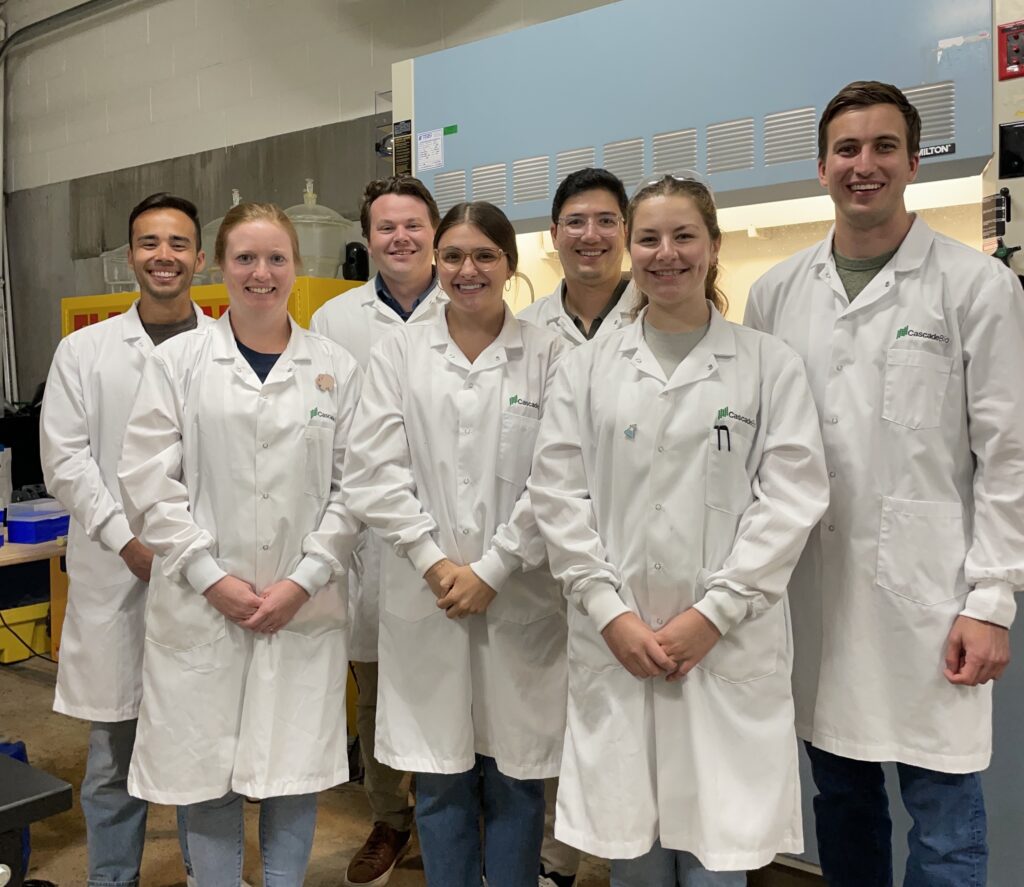
When Alex Rosay contemplates the difficulties of startup life, he draws strength from family history that puts entrepreneurial challenges in stark perspective. His mother arrived from Mexico 50 years ago and became the first in her family to attend college. His grandfather survived the Holocaust after losing his entire family. “While being a founder is difficult,” Alex reflects, “it’s not life or death as my ancestors experienced, or trying to restart a life in a different country.” This fearless mindset, shaped by generational resilience, enables him to tackle seemingly impossible problems.
His co-founder James Weltz, Ph.D., approaches fear differently—through the lens of a rock climber who has learned to manage it. Beginning climbers get “pumped by overgripping,” he explains, but experience teaches you to observe and contextualize fear rather than letting it cripple you. This philosophy extends to their business strategy, where calculated risk-taking has become their competitive advantage.
Together, these complementary approaches to fear have enabled Cascade Bio to chart a contrarian path in synthetic biology, reimagining manufacturing inspired by how nature operates. Founded three years ago, the company is positioning itself as the platform that could fundamentally transform how we manufacture chemicals—taking an approach that industry incumbents might consider too audacious to attempt.
The partnership between Alex and James represents a perfect fusion of business acumen and deep technical expertise. Alex, who came from Zymergen, brought conviction that “biology is the future way of making molecules,” but recognized the need to make it cheaper and more accessible. James, approaching from the technical side, was seeking someone who could build a transformative organization around breakthrough science.
“Cascade Bio harnesses the power of nature to transform the way the world makes chemicals.” - Alex Rosay
For James, the breakthrough came through unexpected cross-pollination. While in college, he was collaborating with scientists working on biocompatibility challenges for medical devices like heart valves and bone screws. Despite tackling different applications, James recognized they were all working at the molecular level—solving similar fundamental problems. This insight sparked a series of experiments in enzyme immobilization that initially succeeded only 1% of the time. But as his approach evolved, success rates climbed dramatically to 99%. “This is the solution that we really need,” James realized, his eyes widening at the implications.
What sets Cascade Bio apart is their platform approach. While the traditional synthetic biology playbook focuses on scaling individual molecules, Cascade Bio is building technology to enable a vast array of chemicals.
The applications are profound. Alex is particularly inspired by methane-to-methanol conversion and the longer-term possibility of eliminating the energy-intensive Haber-Bosch process for fertilizer production. “The atmosphere is 78% nitrogen,” he notes, envisioning enzyme-enabled fertilizer production directly on farms—a distributed approach with massive implications for humanity’s carbon footprint.
Alex and James draw parallels to the semiconductor industry, where the advent of transistors unlocked computation, data storage, and the digital revolution. Similarly, enzyme stabilization could democratize chemical manufacturing, mimicking how nature operates.
Customer obsession drives their technology roadmap. Rather than perfecting technology in isolation, they chose to release early products and solicit feedback—a decision that has shaped their platform development. Their recent funding round will enable them to transition laboratory wins into scaled product delivery, marking their first large-scale biocatalyst deployment. They are already working with over 20 companies making molecules across chemicals, pharmaceuticals, food ingredients, and more.
The company’s hiring pipeline reflects ambitious growth plans, expanding beyond enzyme immobilization into enzyme engineering to broaden their customer base. Their ultimate vision: full-stack biocatalysts that make anyone doing chemistry a potential customer.
Looking toward 2035, their notional headline reads: “Cascade Bio harnesses the power of nature to transform the way the world makes chemicals.” For James, it’s about “lifting the entire industry” rather than betting everything on single applications.
In an era demanding sustainable chemical solutions, Cascade Bio’s platform approach could prove prescient—democratizing access to biological manufacturing and fundamentally reshaping industrial chemistry.